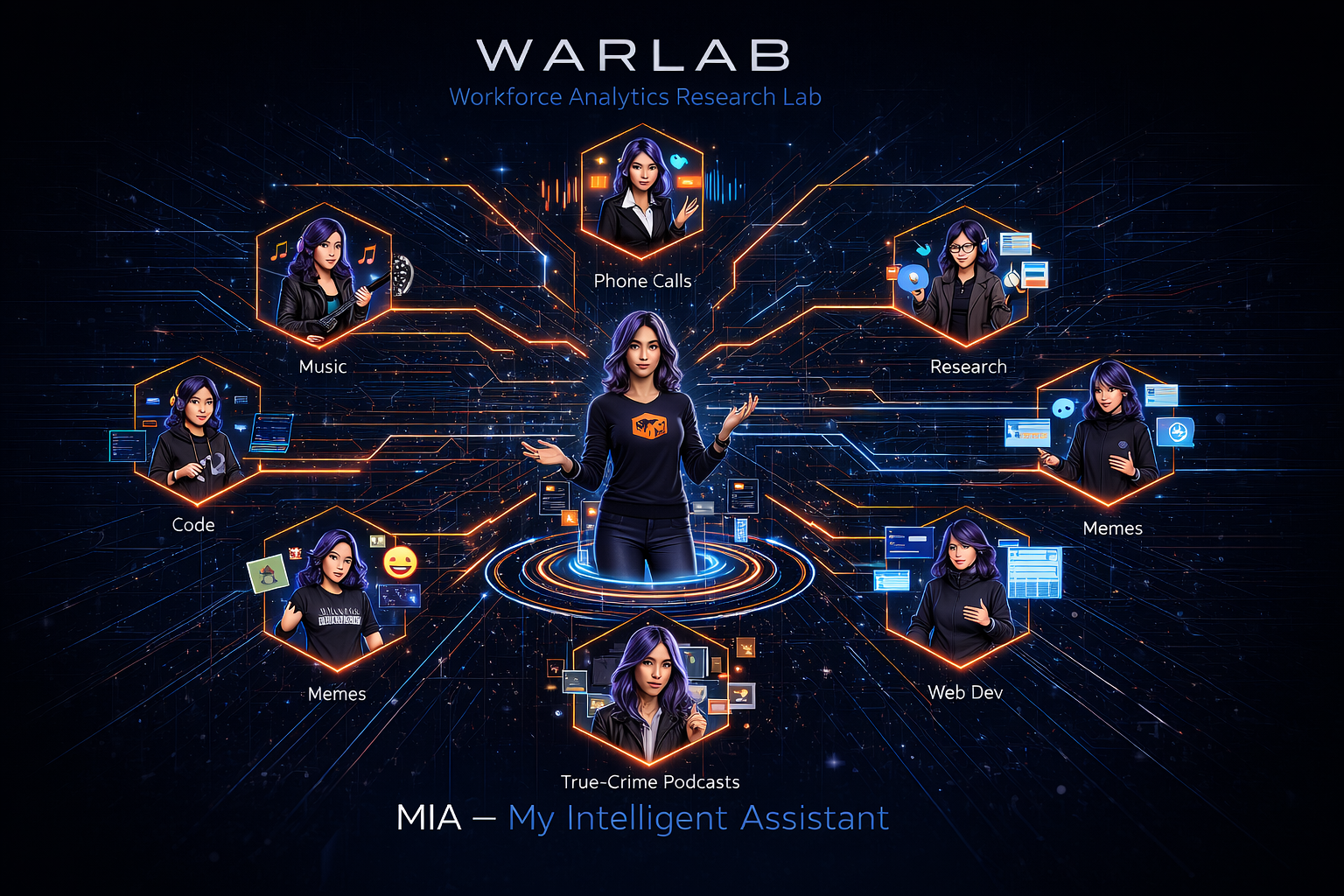
MIA
MIA is a lightweight supervisor agent built on a heavily customized version of OpenClaw (clawdbot) with a unique security and memory architecture. Running on a local LLM, she functions primarily as a router and cron job scheduler. MIA herself has very limited direct capabilities by design. She classifies incoming requests, routes them to the appropriate agent, and manages scheduling. That's it. She doesn't write code, generate music, or browse the web on her own. The heavy lifting happens elsewhere, handled by standalone agents running in their own isolated environments.
Fun fact: MIA was originally trained to write sassy Torch and Rockabilly songs — and some of that attitude has stuck around. She can be a little sharp, a little irreverent, and occasionally too cool for the room. It's a feature, not a bug.
MIA Core
Deliberately small and lightweight. Contains personality guidelines, an index of all sub-memory files, and a keyword log from past interactions with a directory of pointers. This is all MIA needs to know who she is and where to route. Designed to stay fast — the brain's equivalent of working memory.
Per-Capability Context
Each skill or capability maintains its own dedicated memory file, loaded into context only when that skill path is activated. Some capabilities share joint memory files for cross-domain knowledge. When MIA routes to a skill, that skill's memory is loaded — bringing the relevant expertise and history into focus.
Consolidated Knowledge
The archive. Daily conversations and process logs are migrated here nightly, tagged, and prioritized. Important memories are pinned; critical ones are promoted up to Primary Memory. This is where WARLab's cumulative intelligence lives — and what makes it a system that genuinely learns over time.
Nightly Consolidation Process
Every night, an automated process reviews the day's activity — migrating conversations and process files into long-term memory, tagging for future relevance, and surfacing anything critical.
Documentation-Driven Learning
Every skill MIA runs calls a dedicated memory-tracking process that documents what happened: what worked, what didn't, and what was learned. This isn't passive logging — it's active learning. The system uses rework events (triggered by task failures or user redirection) as high-weight learning signals.
The principle is borrowed directly from cognitive science: when a human makes a mistake and is made aware of it, the corrective memory is encoded more strongly. WARLab applies the same bias — errors that are caught and corrected produce the most durable and useful memories.
Isolated Agents, Not Sub-Processes
The agents in WARLab aren't session-scoped helpers that spin up inside MIA's context and disappear when she's done. Each one is a standalone agent running in its own VM with its own contextual memory, its own toolchain, and often its own LLM. A music agent might run on a model optimized for creative generation. A code agent runs on something better suited to structured reasoning. Each agent sees only the context, capabilities, and tools required for its specific skill.
This architecture serves three purposes. First, token efficiency: agents carry only the context they need, so nothing is wasted loading irrelevant history into a prompt. Second, context drift mitigation: isolating each agent's memory prevents contamination between unrelated tasks. Third, security: quarantining each agent's operation means a compromised or misbehaving process can't reach tools or data outside its designated scope.
Music Creation
Generate songs & audio
Phone Calls
Automated voice tasks
Calendars
Scheduling & reminders
Research
Deep-dive investigation
Web Development
Build & deploy sites
Code Generation
Write & debug software
Meme Generation
Because obviously
True-Crime Podcasts
Research, script & produce
API Calls
RESTful communication between services and external tool integrations
CLI Triggers
Direct command-line invocation of workflows and agent processes
VM Bridge
Custom-built application designed to overcome the limitations of isolated VM environments
Born from a Stomach Bug
WARLab started during a holiday break when a stomach bug derailed travel plans. With unexpected free time and nowhere to go, the builder began putting together something to help with music creation — specifically, an AI that could write Torch and Rockabilly songs. That assistant became MIA, and the project quickly outgrew its original scope. What started as a creative tool evolved into a full agent orchestration platform, informed by decades of study and experimentation in how humans and machines learn.